
This article may contain commentary
which reflects the author’s opinion.
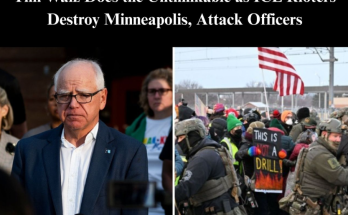
When the Trump administration deployed roughly 2,000 federal immigration agents to the Twin Cities area, they were met by activists who tracked their movements and harassed them outside hotels where they were staying, according to a review of public records and reporting.
The activists are part of a network of left-wing organizations that have collectively received millions of dollars from major liberal foundations and dark-money groups. Those funding sources include some of the most influential players in progressive philanthropy, underscoring the scale of financial support behind the protests, The Washington Free Beacon reported.
At the center of the activity is the Sunrise Movement, a group founded to combat climate change that has since expanded its mission to opposing the Trump administration across a range of issues. Its Twin Cities chapter has focused heavily on immigration enforcement, organizing actions aimed directly at Immigration and Customs Enforcement agents operating in the region.
Sunrise Twin Cities has held in-person “action trainings” that instruct activists on how to “stop ICE” and disrupt federal operations. The group maintains a running list of hotels housing ICE agents and organizes late-night noise demonstrations intended to make it difficult for those hotels to function. The demonstrations are designed to pressure hotel staff and management while targeting agents staying inside.
The Sunrise Movement has received substantial financial backing over several years. Grant disclosures show that it has been awarded millions of dollars from large progressive foundations. The group says it generally declines donations that come with expectations of strategic input and that funds are used to support local chapters through housing, food, travel, training, technology, and materials.
In the Twin Cities, Sunrise has worked in coordination with at least two other groups involved in anti-ICE activity: Unidos MN and Defend the 612.
Unidos MN describes itself as an immigrant-led, multiracial, statewide organization. Through an affiliate known as Monarca, it operates a rapid-response network that includes a 24-hour hotline for reporting ICE activity.
When calls come in, trained responders are dispatched to locations in an effort to observe, confront, or interfere with enforcement actions. Financial filings show that Unidos has received significant funding from major progressive donors and political nonprofits.
Defend the 612 offers similar training programs for activists interested in monitoring federal immigration enforcement. The group provides “ICE Watch” orientations and distributes materials that explain how to document ICE activity.
Its resources include guidance on tracking federal agents and identifying ICE vehicles. In its materials, the group refers to immigration agents as “abductors.”
Donations to Defend the 612 are processed through a Minneapolis-based nonprofit that has itself received funding from prominent left-wing grantmaking organizations.
Another group, Copal MN, also operates an ICE-sighting hotline in the Twin Cities. Public filings show that it has received funding from some of the same dark-money groups backing other anti-ICE organizations in the region.
The coordinated activism intensified in Minneapolis following the Jan. 7 death of 37-year-old resident Renee Good. Authorities say Good was blocking a neighborhood road when ICE agents ordered her to exit her vehicle. Instead, she drove forward. An agent positioned in front of the SUV fired three shots, killing her.
Good’s wife, Becca Good, was present at the scene and urged her to drive as agents approached the vehicle, according to reports.
Becca Good reportedly followed an Instagram account known as “MN Ice Watch,” which describes itself as an autonomous collective documenting and resisting ICE, police, and what it calls colonial militarized regimes.
Training materials posted by the account last year outlined tactics for “de-arresting,” a practice in which activists attempt to pressure or physically interfere with law enforcement to prevent arrests.
One slide encouraged surrounding officers, blocking vehicles, and chanting until police release detainees. Another slide described physically pulling officers away from arrestees, noting that the tactic carries significant risk because it involves direct contact with law enforcement.