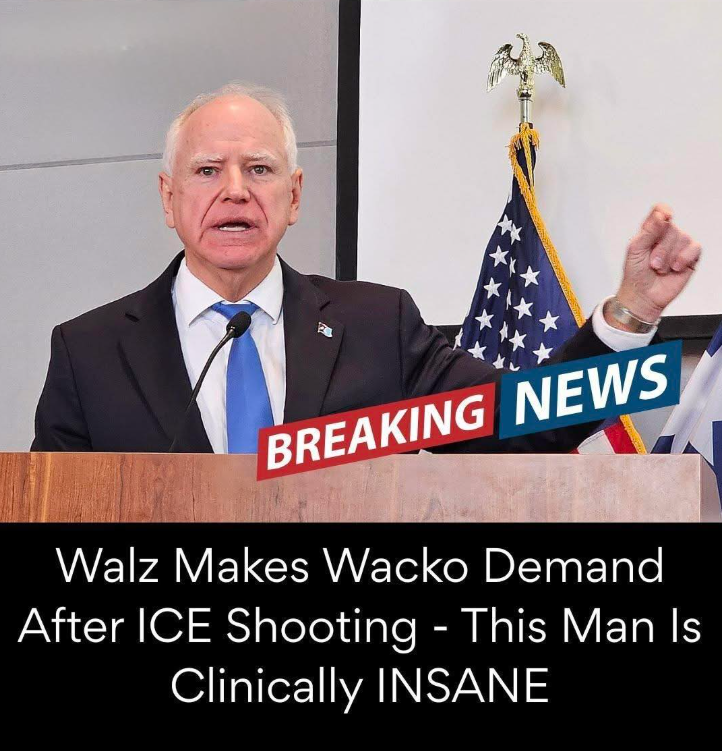
Minnesota Governor Tim Walz is facing mounting criticism after publicly lashing out at federal authorities for refusing to share evidence related to a fatal ICE shooting in Minneapolis—despite the fact that his own administration has spent years discouraging cooperation with federal immigration enforcement.
The contradiction has become impossible to ignore. Walz, who has consistently supported policies limiting state and local engagement with Immigration and Customs Enforcement, is now demanding transparency and collaboration from the very agencies his administration has treated as adversaries.
The dispute stems from the fatal shooting of Renee Nicole Good, a 37-year-old Minneapolis woman who was killed during an ICE enforcement operation earlier this week. The incident has reignited tensions between Minnesota’s Democratic leadership and federal immigration officials, exposing deep fractures between rhetoric and responsibility.
A Deadly Confrontation
According to video footage and preliminary federal accounts, the shooting occurred during an active ICE operation in a residential Minneapolis neighborhood. Agents were attempting to carry out immigration enforcement when Good drove her SUV into the area, reportedly interfering with the operation.
Footage circulating publicly shows a federal agent positioned directly in front of Good’s vehicle. Despite verbal commands to stop, the vehicle is seen shifting from reverse into drive and accelerating toward the agent. Moments later, shots were fired.
Good was transported to Hennepin County Medical Center, where she was pronounced dead.
Federal authorities have stated that the incident is under investigation and that relevant evidence will be released through established legal channels. That response, however, has not satisfied Governor Walz.
Walz Escalates Rhetoric
Instead of urging patience or de-escalation, Walz publicly accused the federal government—specifically the Department of Homeland Security—of withholding information and acting without accountability.
In one of his most inflammatory remarks, Walz suggested that DHS Secretary Kristi Noem was acting as “judge, jury, and executioner,” language that critics say irresponsibly inflames public tensions during an already volatile moment.
The irony, critics argue, is that Walz’s administration has actively worked to prevent cooperation between Minnesota law enforcement agencies and ICE, making his current demands appear opportunistic rather than principled.
Minnesota’s Sanctuary Reality
Minneapolis is a de jure sanctuary city, meaning it has formal policies prohibiting local law enforcement from assisting federal immigration authorities in most circumstances.
Minnesota itself operates as a de facto sanctuary state. Earlier this year, the state attorney general issued a legal opinion strongly advising state and local agencies against cooperating with ICE unless explicitly required by law.
Under Walz’s leadership, this posture has been reinforced politically and rhetorically. The governor has repeatedly criticized ICE operations, framed immigration enforcement as morally suspect, and signaled to activists that federal agents are unwelcome in Minnesota communities.
That context matters—because it directly contradicts Walz’s current insistence that federal agencies owe him full transparency and collaboration.
“You Can’t Have It Both Ways”
Legal analysts and law enforcement officials have been blunt in their assessment: a state cannot actively obstruct cooperation with federal agencies and then demand access to evidence as if it were a full partner.
“You can’t declare non-cooperation, discourage your officers from engaging, and then complain you’re being left out,” said one former federal prosecutor. “That’s not how intergovernmental trust works.”
Federal agencies typically share investigative material with state counterparts when there is mutual cooperation, shared jurisdiction, or formal task-force arrangements. Minnesota has intentionally distanced itself from all three.
Federal Justification for Withholding Evidence
From the federal perspective, the investigation into the shooting is ongoing and involves sensitive use-of-force determinations. Releasing raw evidence prematurely could compromise witness testimony, officer safety, or prosecutorial review.
ICE has stated that the shooting is being handled according to standard federal protocols and that evidence will be disclosed once appropriate investigative steps are completed.
In other words, the federal response is not unusual—except that Minnesota’s leadership is treating it as a political provocation rather than a procedural norm.
Activism, Rhetoric, and Consequences
The incident has also drawn attention to the role of activist convoys and organized interference with federal law enforcement.
Renee Good was not a bystander. By multiple accounts, she was actively attempting to disrupt a lawful federal operation. Using a vehicle to advance toward an officer is widely recognized in law enforcement training and case law as a potentially lethal act.
Independent legal analysts reviewing the video footage have stated that the use of deadly force appears consistent with established standards governing officer self-defense.
That reality has been largely absent from Walz’s public statements.
Political Amnesia Sets In
Just over a year ago, Walz was being discussed as a potential vice-presidential nominee—one heartbeat away from the presidency. Today, critics say the episode highlights why that prospect alarmed many Americans.
The same political faction that spent years accusing law enforcement of systemic violence is now demanding transparency from federal agents—after helping create an environment in which those agents operate without state support and under constant political hostility.
“This is what happens when rhetoric replaces governance,” said one Minnesota law enforcement official. “You encourage confrontation, you discourage cooperation, and then you act shocked when things go wrong.”
A Growing Credibility Problem
As more facts emerge, the gap between Walz’s narrative and the documented evidence continues to widen.
Video footage contradicts claims that the shooting was unprovoked. Minnesota’s own policies contradict Walz’s demands for cooperation. And his rhetoric risks inflaming tensions at a moment when restraint would better serve public safety.
Federal investigators will complete their review. Evidence will be released. Legal conclusions will follow.
The larger question, however, may not be about the shooting itself—but about whether Minnesota’s leadership is prepared to take responsibility for the policies and rhetoric that helped shape the conditions under which it occurred.
For now, Governor Walz appears trapped by his own contradictions—denouncing federal authority while demanding its accountability, rejecting cooperation while insisting on transparency, and fueling outrage while calling for calm.
It is a paradox of his own making.