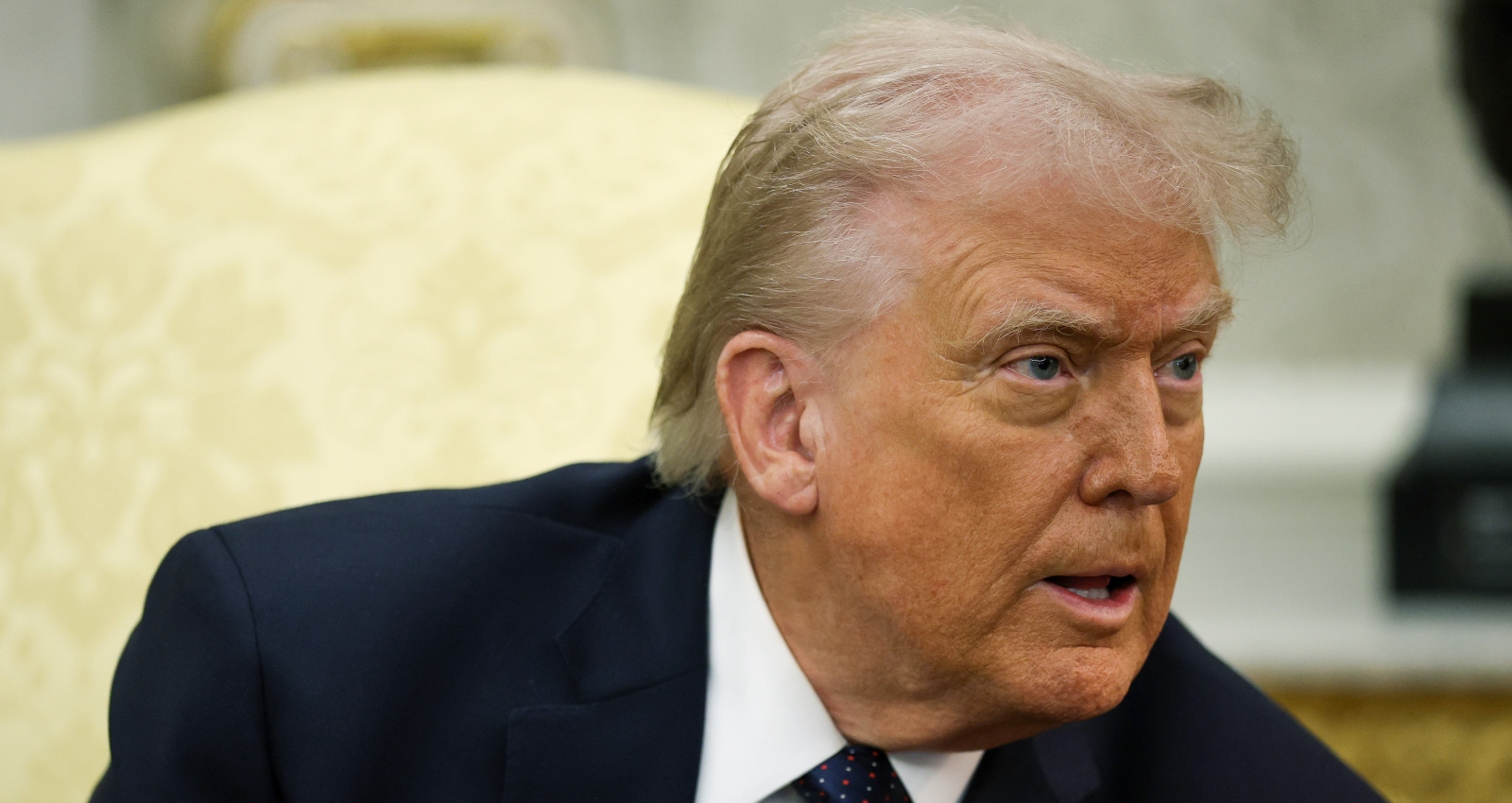
President Donald Trump said Friday that the United States will not reach an agreement with Iran unless the country accepts what he called “unconditional surrender.” Trump made the statement in a post on Truth Social.
“There will be no deal with Iran except UNCONDITIONAL SURRENDER!” Trump wrote, Newsmax reported. The president also suggested that a future Iranian government could receive economic assistance from the United States and its allies after accepting those terms.
“After that, and the selection of a GREAT & ACCEPTABLE Leader(s), we, and many of our wonderful and very brave allies and partners, will work tirelessly to bring Iran back from the brink of destruction, making it economically bigger, better, and stronger than ever before,” Trump wrote.
Trump also expressed optimism about Iran’s long-term future. “IRAN WILL HAVE A GREAT FUTURE,” Trump wrote. The president concluded the message with a slogan modeled on his well-known campaign motto. “MAKE IRAN GREAT AGAIN (MIGA!),” Trump wrote.
A US Navy destroyer stationed off the coast of a Middle Eastern nation is equipped with the new High-Energy Laser with Integrated Optical Dazzler and Surveillance (HELIOS) system, as shown in videos released by US Central Command. This state-of-the-art laser device features a steerable head that can concentrate an intense, tightly focused beam of energy to eliminate drones, according to military observers.
Additionally, videos captured the skies over the Israel-Lebanon border, revealing the launch of rockets that exploded seconds later. This phenomenon has been widely but unofficially attributed to the Israeli military’s new Iron Beam weapon, an advanced laser technology designed to disable rockets and protect territorial integrity, the New York Post reported.
Advertisement
Neither the US Navy nor the Israeli military has confirmed or denied the use of lasers during the Epic Fury operation, which began on February 28. However, the Navy did state at the beginning of February that it had successfully taken out four drones during a test of the HELIOS system.
During the first 72 hours of the battle, U.S. forces struck 1,700 targets. They destroyed over 200 of Iran’s ballistic missile launchers, which is about half of what the country possessed. Additionally, several more launchers were rendered inoperable. Hundreds of missiles were destroyed, preventing them from causing damage, The Post noted.
The U.S. precision strikes against missile silos, nuclear facilities, and key leaders have been hailed as a significant success, with minimal losses on both U.S. and Israeli sides. The strikes were made possible by devices operated from higher altitudes than before—specifically, from space, the outlet added.
The US Space Force, established in 2019, is essential for air and sea forces to determine when to attack, when to take cover, and the locations of enemy missiles.
They do it “with satellites that have infrared sensors for finding where rockets are being fired,” Brent David Ziarnick, former professor in the Space Force program at Johns Hopkins University and retired Air Force officer, told The Post.
“They can spot the missiles and pinpoint where the launchers are. The missiles can be intercepted and destroyed [often with Patriot Missiles]. Field forces get notified that an attack is coming, so they can go to shelters or bunkers,” he added, per the outlet.
The Space Force utilizes infrared beams to track missiles the moment they are launched, picking up on the heat they generate. According to ABC News, this advanced technology has successfully destroyed hundreds of Iranian missiles.
Remarkably, even with the ongoing conflicts in the Middle East, most of the Space Force’s operations are conducted from within the United States, The Post reported.
Teams work inside radar domes known as Radomes, which resemble giant golf balls. These structures receive real-time data from the skies, allowing them to calculate missile trajectories and predict their likely destinations, enabling timely defensive actions.