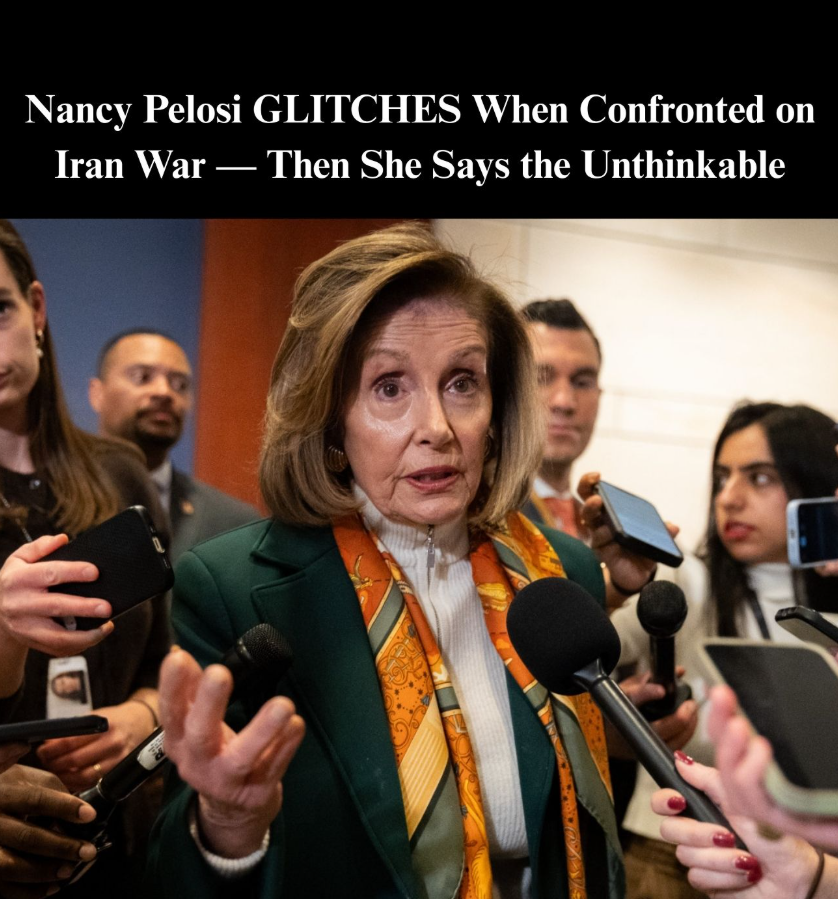

A resurfaced video clip of former House Speaker Nancy Pelosi defending President Barack Obama’s 2011 military strikes in Libya without congressional authorization is drawing renewed attention as Democrats criticize President Donald Trump’s decision to launch strikes against Iran.
In the clip, recorded during a 2011 press event, a reporter asked Pelosi whether Obama needed congressional approval to conduct the military operation in Libya.
“You’re saying that the president did not need authorization initially and still does not need any authorization from Congress on Libya?” the reporter asked.
“Yes,” Pelosi replied.
The remark contrasts sharply with Pelosi’s response to Trump’s weekend strikes against Iran, which she condemned as unconstitutional without prior approval from Congress.
“President Trump’s decision to initiate military hostilities into Iran starts another unnecessary war which endangers our servicemembers and destabilizes an already fragile region,” Pelosi wrote in a post on X.
“The Constitution is clear: decisions that lead our nation into war must be authorized by Congress,” she added, referencing the 1973 War Powers Act.
Pelosi’s office has argued that the two situations are fundamentally different.
“There is an absolute distinction between the limited military operations in Libya and the broad, escalating war with Iran initiated by President Trump,” Pelosi spokesperson Ian Krager said.
“Speaker Pelosi’s position has been consistent: when the prospect of expansive or prolonged hostilities exists, the Constitution and the War Powers Act are clear that Congress must authorize it.”
WATCH:
Advertisement
Trump authorized the strikes as part of a joint U.S.-Israeli operation targeting Iran’s military leadership and infrastructure.
The operation killed Iranian Supreme Leader Ayatollah Ali Khamenei and other senior officials, according to U.S. officials, in what the administration described as a necessary move to prevent Iran from obtaining a nuclear weapon.
Pelosi and other Democrats are now pushing a War Powers resolution that would limit Trump from conducting additional military operations against Iran without explicit congressional authorization.
The controversy has revived comparisons to Obama’s 2011 intervention in Libya, known as Operation Odyssey Dawn. In March of that year, Obama ordered U.S. and NATO forces to conduct airstrikes against Libyan government positions to stop Muammar Gaddafi’s forces from attacking civilian protesters during the Libyan uprising.
Obama consulted congressional leaders before the strikes but did not seek a formal declaration of war.
“We struck regime forces approaching Benghazi to save that city and the people within it,” Obama said at the time.
The intervention did not initially remove Gaddafi from power, though the Libyan leader was eventually killed by rebel forces later that year as his regime collapsed.
Republicans argue Pelosi’s past comments demonstrate a double standard as Democrats now criticize Trump’s use of military force.
Fox News correspondent Bill Melugin asked House Minority Leader Hakeem Jeffries about the discrepancy.
Jeffries responded that the situations were fundamentally different.
“Iran is very different,” Jeffries said, adding that he did not understand the premise of the question and noting he was not serving in Congress at the time of the Libya operation.
When Melugin pointed out that the Libya bombing campaign lasted seven months and included a NATO-enforced no-fly zone, Jeffries reiterated his criticism of the current administration, arguing that the Trump administration “isn’t even pretending to have intelligence at this point” to justify the strikes against Iran.
The debate highlights a growing divide in Washington over presidential war powers as the United States becomes increasingly involved in a widening conflict with Iran. Democrats have largely condemned the operation as unconstitutional without congressional authorization, while many Republicans argue the president has the authority as commander-in-chief to act against foreign threats without a formal declaration of war.