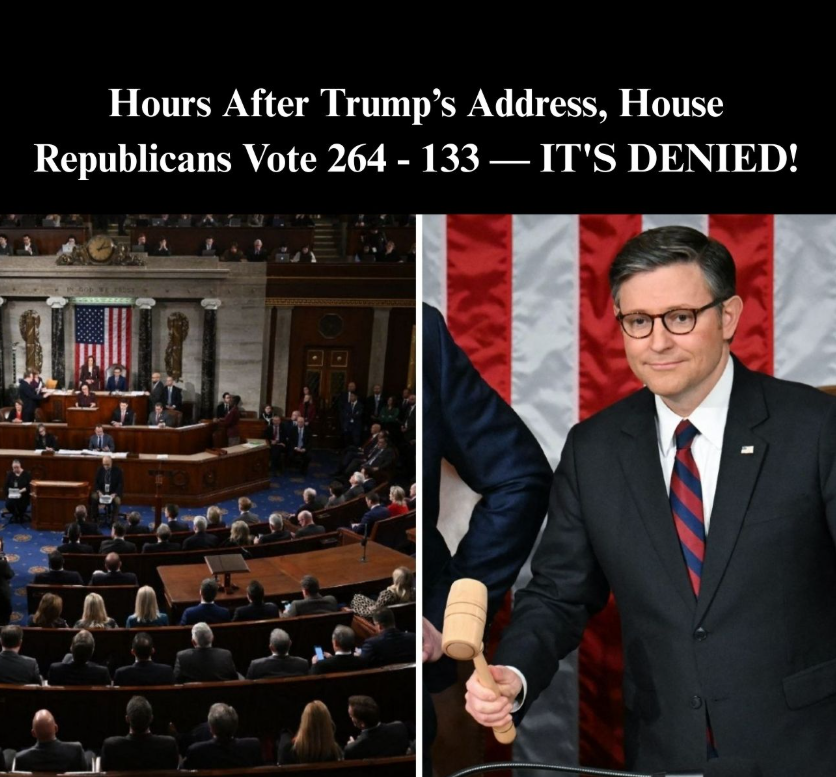

The House on Tuesday rejected the ROTOR Act, delivering a setback to bipartisan air safety legislation and casting uncertainty over its future. Lawmakers voted 264 to 133 against the bill, falling short of the two-thirds majority required under the fast-track procedure, with more than 130 Republicans opposing the measure.
“We came within a couple of votes,” Senate Commerce Chair Ted Cruz, R-Texas, told reporters, Politico reported.
“An overwhelming majority of the House voted for ROTOR, and I believe we’re going to pass it,” he said, later calling the outcome a “temporary delay.”
The Senate unanimously approved the legislation, S 2503, in December, but it stalled in the House amid opposition from Transportation Chair Sam Graves, R Missouri, who recently introduced his own bipartisan proposal in response to the January 2025 crash near Ronald Reagan Washington National Airport that killed 67 people.
Victims’ families said they were “devastated” by the vote and urged House leadership to bring the ROTOR Act back to the floor.
Graves told POLITICO after the vote that he did not view the outcome as tanking the bill but as an opportunity for additional House input.
“Still got work to do,” Graves said.
“I don’t look at it as tanking the bill, I just look at it as now we’ll get some House input,” he added.
Graves said he plans to mark up his competing proposal, the ALERT Act, as soon as possible.
The ROTOR Act would require aircraft operating in busy airspace nationwide to install Automatic Dependent Surveillance Broadcast In, known as ADS-B In, technology designed to enhance real-time aircraft location awareness.
Advertisement
Graves, a pilot, has argued that the mandate would burden general aviation operators.
The legislation is backed by victims’ families, labor groups and National Transportation Safety Board Chair Jennifer Homendy.
The Defense Department previously supported the bill but reversed course Monday, stating that enactment would create “significant unresolved budgetary burdens and operational security risks affecting national defense activities.”
House GOP leaders privately told members they could allow the bill to fail to address concerns, though Graves and Armed Services Chair Mike Rogers, R Alabama, were not publicly whipping votes against it.
House Speaker Mike Johnson, R Louisiana, and Majority Leader Steve Scalise, R Louisiana, voted against the measure, while the ranking Democrats on the Transportation and Armed Services committees voted in favor.
A preliminary NTSB staff analysis shared with Congress concluded that a key provision of the ALERT Act would not implement the agency’s ADS B In recommendation and warned it “would seriously harm our efforts to implement ADS B In at FAA.”
Homendy said the Transportation and Armed Services committees did not consult her before releasing the ALERT Act text.
Rep. Don Beyer, D-Virginia, a supporter of the ROTOR Act, said he was heartbroken by the outcome.
“It was unnecessary to lose all those Republicans,” Beyer said, noting that some Democratic absences were due to a historic blizzard in New England.
“On a normal day,” he said, the bill “would have passed.”
In a joint statement, victims’ families said the legislation “was not defeated on its merits” but by “eleventh-hour objections built on misleading technical claims” and the Pentagon’s reversal.
They called on House leadership to hold another vote under a simple majority threshold, adding, “We are not done.”