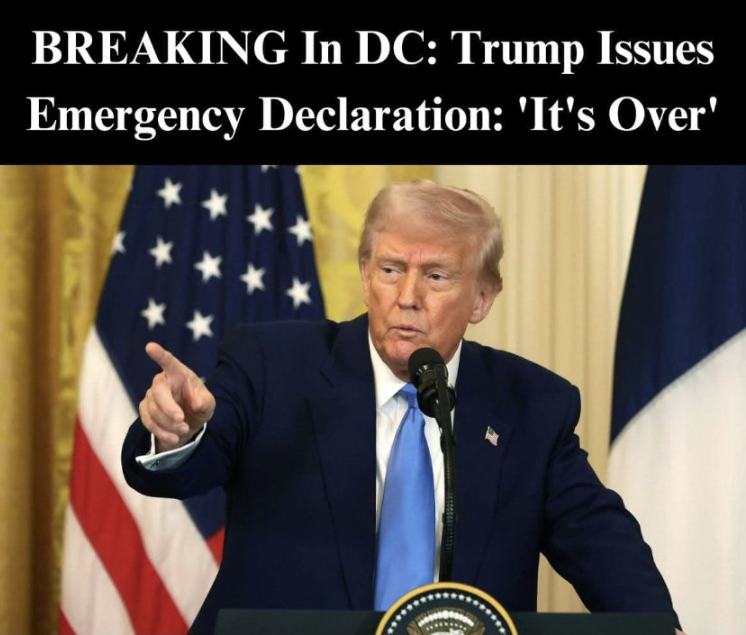

President Donald Trump kept complaining on Monday about the U.S. Supreme Court’s recent decision to block his wide-ranging tariffs. Since the decision on Friday, Trump has posted at least six messages on Truth Social criticizing the Supreme Court.
Trump wrote on Truth Social that the court “accidentally and unknowingly” gave him “far more powers and strength” than before the “internationally divisive” ruling. He also hinted that he expects to lose another legal battle after the court hears arguments about his executive order ending birthright citizenship.
“I can use Licenses to do absolutely ‘terrible’ things to foreign countries, especially those countries that have been RIPPING US OFF for many decades, but incomprehensibly, according to the ruling, can’t charge them a License fee — BUT ALL LICENSES CHARGE FEES, why can’t the United States do so?” Trump said in his post.
The court’s 6-3 decision on Friday dealt a major blow to Trump’s economic and trade agenda. After the ruling, the president announced first a 10 percent and, later, 15 percent global tariff.
The rare rejection of the president’s priorities by the conservative-leaning court quickly drew Trump’s anger, and he lambasted the majority justices as “unpatriotic and disloyal to our Constitution.”
In a separate post on Monday, Trump appeared to warn other countries he is still willing to impose tariffs on them.
“Any Country that wants to ‘play games’ with the ridiculous supreme court decision, especially those that have ‘Ripped Off’ the U.S.A. for years, and even decades, will be met with a much higher Tariff, and worse, than that which they just recently agreed to,” he said. “BUYER BEWARE!!!”
The president also said that the court has upheld other tariffs since he took office, and they can all be used in a much stronger and more annoying way, with legal certainty.
In another post on Monday, the president said that he doesn’t need Congress’s approval to put tariffs in place.
“It has already been gotten, in many forms, a long time ago! They were also just reaffirmed by the ridiculous and poorly crafted supreme court decision!” Trump said.
On Sunday, U.S. Trade Representative Jamieson Greer explained how the Trump administration’s tariff policy will continue, even though the Supreme Court ruled on Friday that most of the president’s main economic policy was illegal.
“The legal tool to implement it, that might change, but the policy hasn’t changed,” Greer told ABC News’ “This Week” co-anchor Martha Raddatz. “And so, we’re aiming for continuity. There’s a 15% tariff now. It’s roughly equivalent to the types of tariffs that we had in place under IEEPA.”
While acknowledging the president is more constrained now, Greer insisted the White House still has “durable tools” to impose tariffs.
“We found ways to really reconstruct what we’re doing. Now, it doesn’t have the same flexibility that the president had under the previous authority that he was using, but he gives us very durable tools,” Greer said. “It allows us to do investigations, implement tariffs where needed, and provides a lot of leverage and a lot of protection for American industry.”
Trump is putting a new global tariff rate of 15% into effect under Section 122 of the Trade Act of 1974. That rate is lower than what some of the country’s biggest trading partners pay under IEEPA, but it is higher than the 10% base global tariff rate that the law put in place. This will make rates higher for many countries.
But the tariff can only be set at a maximum of 15% for a maximum of 150 days. After that, Trump will need permission from Congress to keep it going.
Greer said that after that date, there were other ways to impose tariffs. For example, under Sections 301 and 232, the US could look into trading partners for violations of trade rights or threats to national security.
“I think we all found out during the pandemic that even things like textiles, people thought, this isn’t a big deal, but we have to have personal protective equipment for our hospitals, we have to have uniforms for our military,” Greer said.
That doesn’t necessarily mean the White House is going to make a national security argument around textile imports, Greer added, but he said there are “things that people might think are ho-hum commodities [that] actually become quite strategic when it comes to national security.”
WATCH: