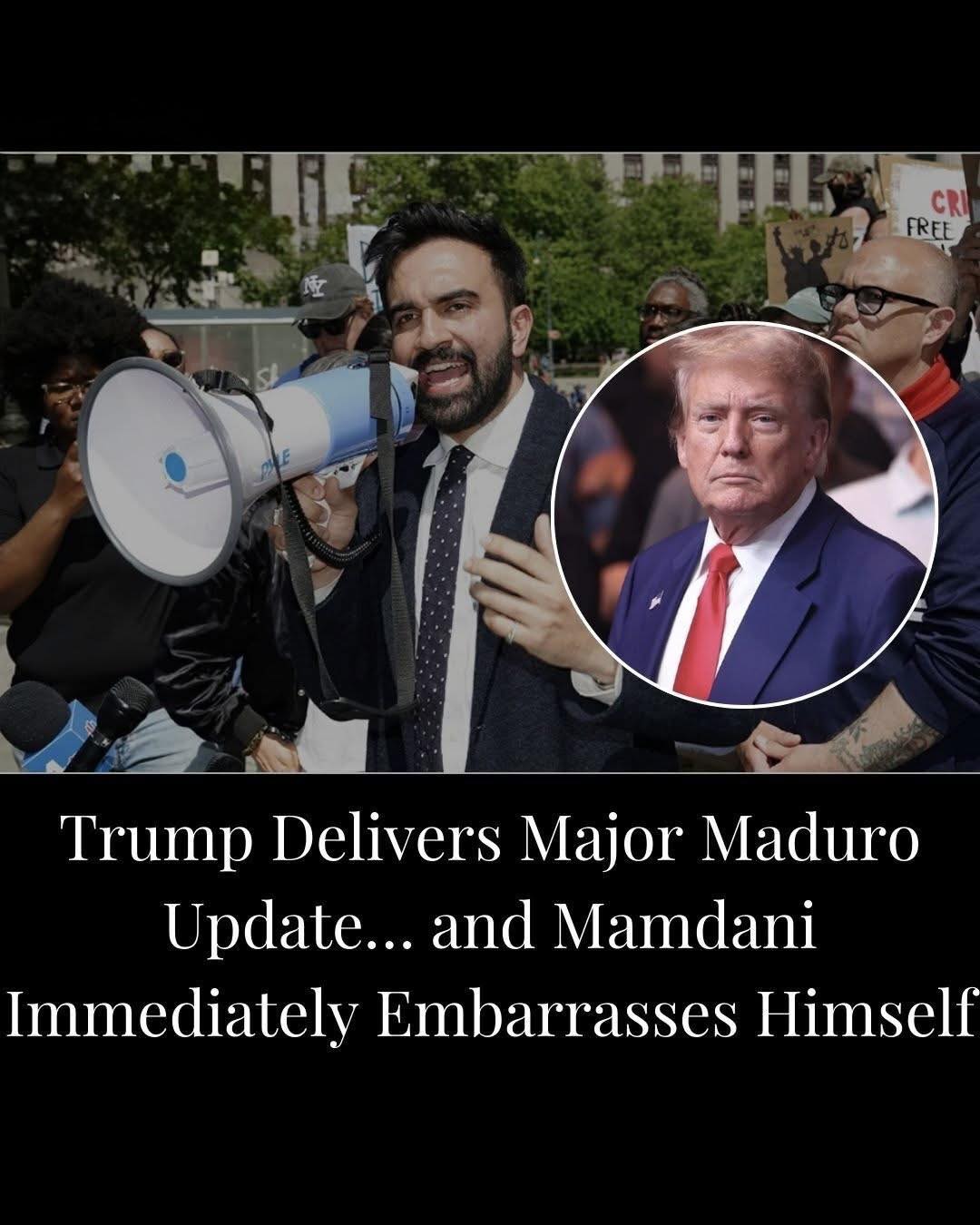
It has become one of the most predictable patterns in modern American politics: when President Donald Trump delivers a decisive blow against an adversary of the United States, Democrats respond not with unity or relief, but with outrage — and often with sympathy for the very regime America just confronted.
The latest example may be the most dramatic yet.
In a stunning overnight operation announced directly by Trump himself, U.S. forces captured Venezuelan strongman Nicolás Maduro and his wife, Cilia Flores, effectively dismantling the leadership of a regime long accused of drug trafficking, human-rights abuses, and economic plunder. Alongside the arrest came another revelation that set Washington ablaze: the United States is moving to secure Venezuela’s vast oil reserves to prevent them from falling into the hands of hostile actors.
For many Americans, the response was simple: finally.
For Democrats, it was fury.
A BOLD MOVE — AND A FAMILIAR REACTION
Within hours of the announcement, progressive lawmakers, activists, and media figures flooded social platforms with accusations. Some called the operation “imperialist.” Others labeled it “illegal.” A few even described Maduro — a man accused by U.S. prosecutors of running a narco-state — as a victim of American aggression.
None of this surprised anyone who has watched the past decade unfold.
Trump removes ISIS leadership? Democrats warn about escalation.
Trump pressures NATO allies to pay their share? Democrats call it destabilizing.
Trump confronts China? Democrats accuse him of provoking conflict.
Now Trump removes a cartel-linked dictator from power? Democrats claim moral outrage.
At this point, the reflex is automatic.
WHY MADURO MATTERED
To understand the magnitude of the operation, it helps to understand what Maduro represented.
Under his rule, Venezuela collapsed from one of Latin America’s wealthiest nations into an economic wasteland. Inflation soared into the millions of percent. Millions fled the country. Cartels flourished. Terror-linked criminal groups operated openly. Oil revenue — once the backbone of the Venezuelan economy — was siphoned off to enrich elites while citizens starved.
U.S. intelligence and law-enforcement agencies have long accused Maduro’s inner circle of facilitating large-scale narcotics trafficking through the so-called “Cartel of the Suns,” using state institutions as cover. Venezuela became not just a failed state, but a strategic liability in the Western Hemisphere.
From Trump’s perspective, leaving that situation unresolved was not diplomacy — it was negligence.
THE OIL FACTOR — AND THE REAL SOURCE OF DEMOCRAT ANGER
The detail that truly enraged Democrats wasn’t just Maduro’s capture. It was the follow-up.
Venezuela holds the largest proven oil reserves on the planet — larger than Saudi Arabia’s. For years, those reserves sat under the control of an anti-American regime that courted China, Russia, and Iran while choking its own people.
Trump’s announcement made clear that the United States would no longer allow those resources to be weaponized against American interests or used to prop up hostile powers.
That reality exposed a deep ideological divide.
To Trump and his supporters, securing those reserves is about:
• Energy independence
• National security
• Weakening adversarial regimes
• Stabilizing global markets
• Preventing cartel financing
To many Democrats, however, any American assertion of power abroad — especially when it benefits U.S. energy security — is treated as inherently suspect.
The result? A bizarre spectacle where critics seemed more upset about America gaining leverage than about a narco-dictator losing power.
LEGALITY, AUTHORITY, AND THE HYPOCRISY GAP
Democrats wasted no time questioning the legality of the operation. Yet many of the same voices spent years defending drone strikes, covert raids, and military actions under previous administrations — often with far less transparency.
The Trump administration, by contrast, laid out a clear framework: Maduro was already indicted in U.S. courts on drug trafficking and terrorism-related charges. The operation was conducted under national-security authority. The oil assets in question were not “seized” from the Venezuelan people but removed from the control of a criminal regime.
But legality was never really the point.
The real issue is that Trump acted decisively — without asking permission from progressive activists, foreign NGOs, or legacy media editorial boards.
That alone is unforgivable in certain circles.
THE DEEPER IDEOLOGICAL SPLIT
This episode revealed something bigger than partisan disagreement. It highlighted two completely different worldviews.
One side believes American power should be restrained, apologized for, and diluted — even when confronting criminals, dictators, or cartels.
The other believes American power exists for a reason — to protect citizens, secure interests, and impose consequences when diplomacy fails.
Trump operates squarely in the second camp.
Democrats increasingly operate in the first.
That divergence explains why Democrats often appear to side instinctively with foreign regimes over their own country when Trump is involved. It’s not about Maduro specifically — it’s about opposing Trump’s philosophy of strength.
WHY THIS RESONATES WITH VOTERS
Outside Washington, the reaction has been very different.
Polls consistently show Americans support:
• Strong border enforcement
• Energy independence
• Tough stances against drug trafficking
• Accountability for foreign criminals
• Reduced reliance on hostile regimes
Trump’s operation checked every box.
For working families facing high energy costs, inflation, and global instability, the idea of neutralizing a cartel-linked dictator while strengthening America’s energy position makes intuitive sense.
Democratic outrage, by contrast, feels abstract — driven more by ideology than by lived reality.
THE TRUMP DOCTRINE IN ACTION
If there is a single takeaway from the Maduro operation, it’s this: Trump governs exactly as he promised.
He doesn’t wait for international consensus.
He doesn’t outsource American interests.
He doesn’t confuse restraint with weakness.
And when an opportunity arises to remove a threat while advancing U.S. security, he takes it — regardless of elite opinion.
Democrats may hate that. They may denounce it. They may protest it endlessly.
But for millions of Americans, it looks like leadership.
THE BOTTOM LINE
The capture of Nicolás Maduro and the securing of Venezuela’s oil reserves didn’t just remove a dangerous regime — it exposed the political fault lines of modern America.
One side sees American power as a liability to be restrained.
The other sees it as a tool to be used responsibly — but decisively.
Trump chose decisiveness.
Democrats chose outrage.
And in the end, voters will decide which vision they prefer.