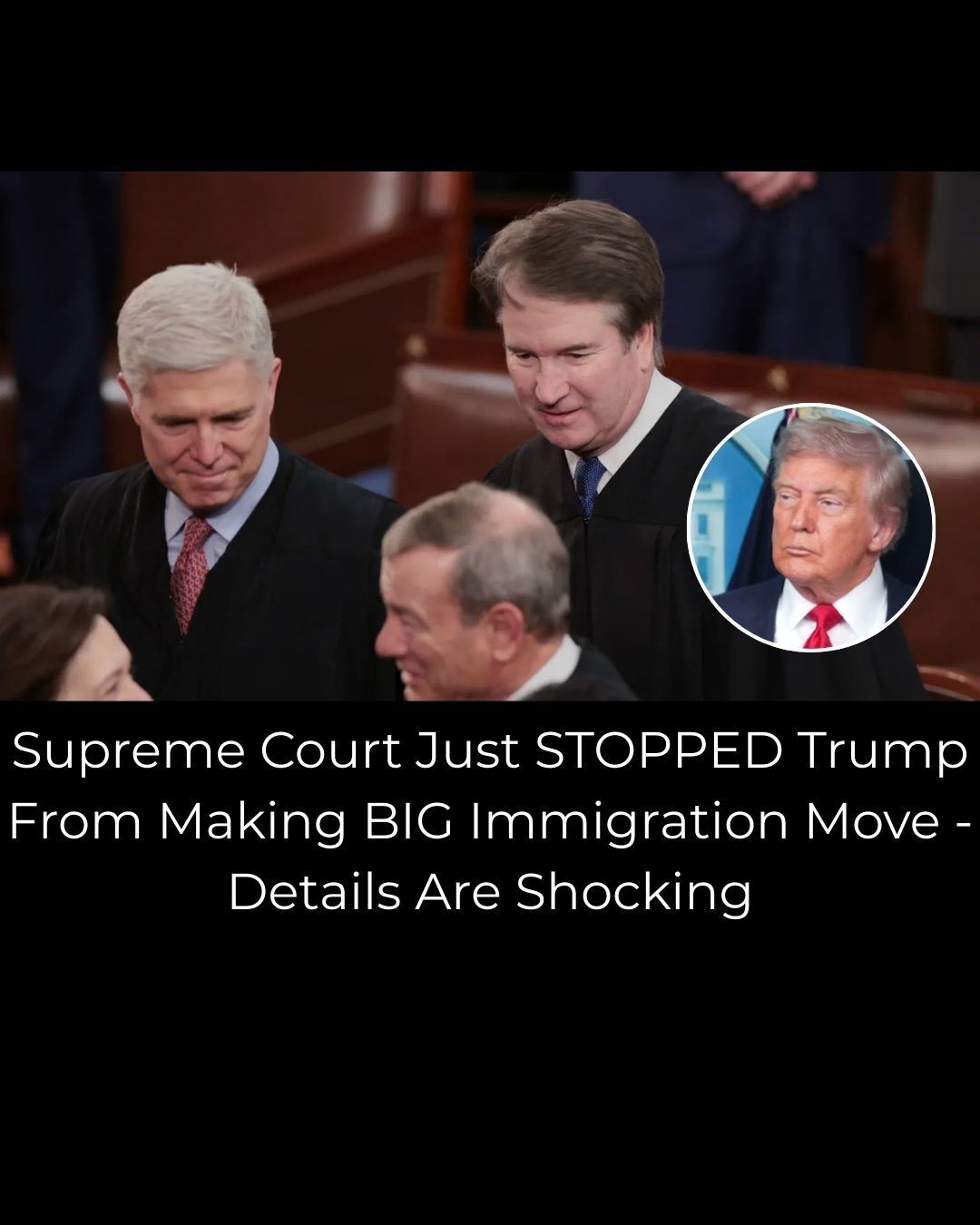
In another setback for the Trump administration’s effort to rein in what it views as a rogue immigration bureaucracy, the U.S. Supreme Court on Friday denied an emergency request for a stay in a high-stakes case involving immigration judges.
The dispute centers on whether immigration judges—who work within the Executive Office for Immigration Review (EOIR) and ultimately report to the Attorney General—can be treated as independent political actors rather than employees of the executive branch.
The lawsuit, brought by the National Association of Immigration Judges (NAIJ), challenges an EOIR policy that prohibits immigration judges from speaking publicly, even in their personal capacities, about immigration policy or the agency itself. The plaintiffs argue the restriction violates their First Amendment rights.
EOIR oversees the nation’s immigration courts and employs approximately 750 immigration judges nationwide.
The Trump administration argued that the Civil Service Reform Act of 1978 (CSRA) requires immigration judges to pursue employment-related claims through the Merit Systems Protection Board (MSPB), rather than in federal court.
Congress designed the CSRA specifically to prevent this kind of judicial end-run, channeling workplace disputes through the MSPB and the Office of Special Counsel before permitting any court review.
But the U.S. Court of Appeals for the Fourth Circuit cast doubt on the scheme’s “continued vitality” after President Trump dismissed the Special Counsel and an MSPB member, leaving the board without a quorum and effectively unable to function.
The underlying lawsuit seeks to further insulate immigration judges from presidential oversight, effectively transforming them into untouchable bureaucrats accountable to no one.
By denying the stay, the Court has allowed this dangerous theory to continue moving through the lower courts. The Trump administration warned that leaving the ruling in place—even temporarily—would inflict irreparable harm on the president’s constitutional authority to supervise executive officers and faithfully execute the nation’s immigration laws.
Immigration judges are not Article III judges. They are employees of the Department of Justice. They do not enjoy lifetime appointments. Yet under Biden-era policies and activist litigation, they are increasingly treated as though they operate entirely outside the executive chain of command.
“A federal appeals court had sent the challenge by a group representing the judges back to a federal trial court for more fact-finding on the independence of the administrative scheme set up to deal with claims by federal employees, and – in a brief unsigned order – the justices left that ruling in place,” SCOTUS Blog reported on Friday.
“However, the court also left open the possibility that the government could return to the Supreme Court to seek relief ‘if the District Court commences discovery proceedings’ before the justices rule on the government’s petition for review of the lower court’s decision,” the blog added.
Law professor Stephen Vladeck, who closely watches all cases before the nation’s highest court, stated on social media that Friday’s order was the Trump administration’s “first real loss” at the Supreme Court since April of this year.
The dispute centers around a policy that the National Association of Immigration Judges (NAIJ) claims prohibits its members from discussing immigration issues and the agency that employs them in their personal capacity. The NAIJ filed a lawsuit in federal court in Alexandria, Virginia, challenging this policy on the grounds that it infringes on their members’ First Amendment rights.
However, U.S. District Judge Leonie Brinkema, a Clinton appointee, dismissed the case, stating that under the Civil Service Reform Act, the NAIJ must pursue its claims through the appropriate administrative process.
U.S. Solicitor General D. John Sauer appeared before the justices Dec. 5 in seeking to block the 4th Circuit’s ruling, arguing that “‘unelected judges’ do not get ‘to update the intent of unchanged statutes if the court believes recent political events … alter the operation of a statute the way Congress intended.”
Moreover, Sauer added, the 4th Circuit’s ruling had already created “destabilizing uncertainty” that could “extend beyond federal personnel actions” to other “administrative-review schemes that preclude district-court jurisdiction,” like the Federal Trade Commission.